Canicross hiking in Swedish Lapland — The Skimate guide
Guide
Published on 31 May 2026
There is something we try to pass on to every guest who leaves here: what we do in canicross hiking is less an activity than a way of being together. With your dog, with the terrain, with a season that is beginning or slowly fading. At 65°N, it changes everything.
This guide is for the gentle dreamers wondering what canicross hiking at Skimate really looks like — in spring when nature wakes up, in autumn when the ruska settles in.
What exactly is canicross hiking?
Canicross hiking is walking with your dog attached to you — by an elastic leash connected to a harness worn at the waist. The dog can pull, or not. It can follow, or not. The equipment frees your hands, absorbs the jolts, and leaves everyone (human and dog alike) the choice of their own pace.
It is not canicross racing. No timer, no competition, no imposed pace. It is a shared walk — sometimes fast, often contemplative, always adapted to who walks with whom.
The equipment comes down to: a suitable harness for the dog, an elastic leash of about 2 meters, and a comfortable human harness. The harness you bring (it is the equipment that must be adjusted to your dog). For leashes and the human harness, we lend the equipment — but if you have your own, already tested and validated on outings, we recommend you bring it.
Why Lapland for canicross hiking?
Space. That is the first thing that strikes you when you move away from the stuga. Boreal forests extending without visible limits, forest paths disappearing between the pines, golden peatlands, lakes followed for hours without meeting anyone. Human density is low. Very low.
Light, then. In spring it returns slowly after winter and stretches the days. In autumn it becomes glancing, oblique, and transforms the birches into gold. This light of the North is what makes each outing different from the last.
And then there is what we encounter — or what we do not encounter. We will speak later of moose, of the return of cranes, of the traces we read in mud or melting snow. That is what it is like to walk in the North with your dog: never knowing exactly what you will see, but knowing you will see something.
May and June — nature waking up
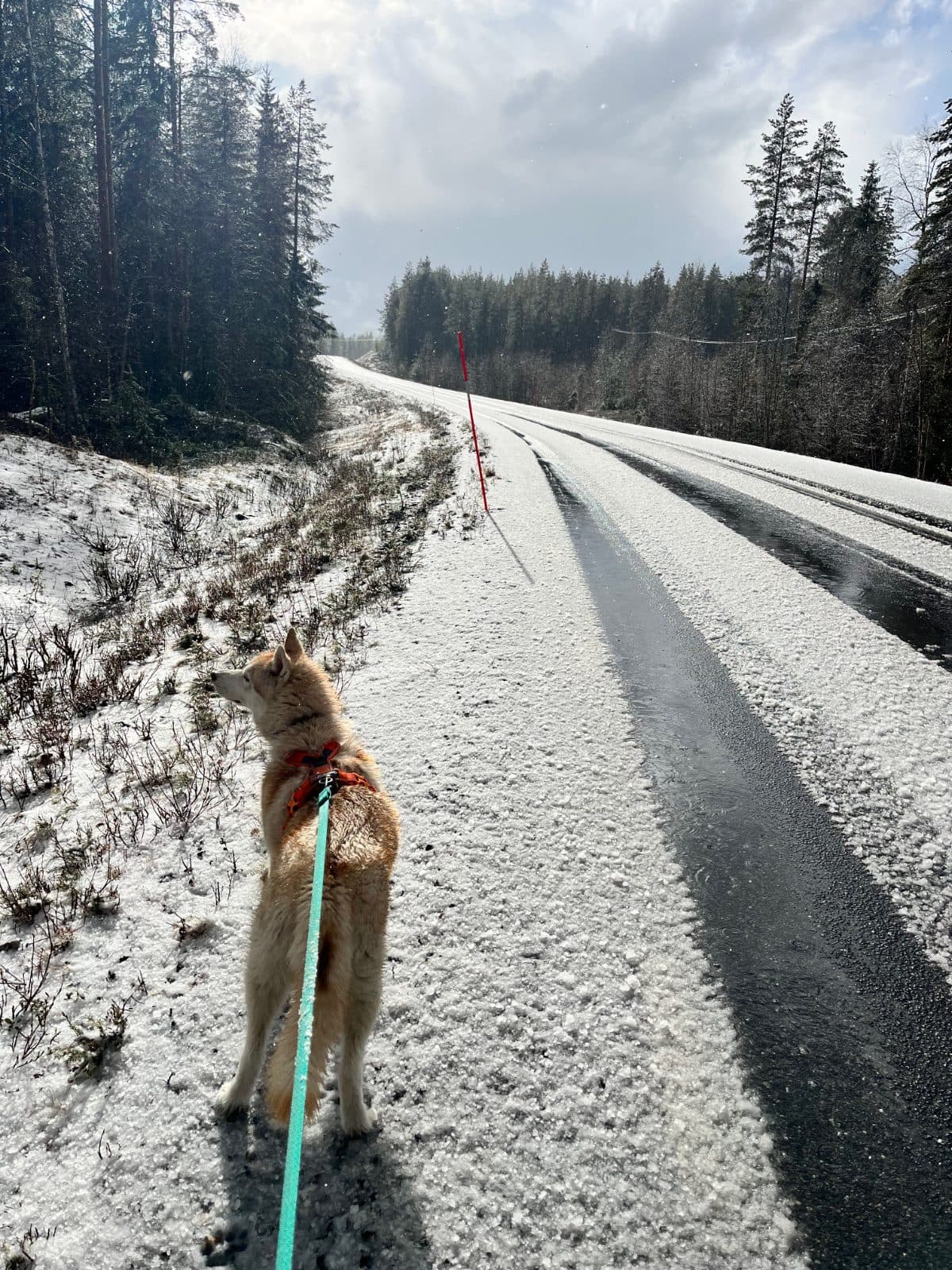
In spring, we leave when we are ready. When the light is good, when the temperature is right, when the dogs show signs of desire. There is no fixed schedule — it is one of the freedoms this way of life offers.
Outings last from 1 hour to 6 hours depending on the itinerary we choose together. Some paths leave the stuga on foot, directly. For others, we take the car to a trailhead — and there it is another forest, another lake, another landscape. We adapt according to your fitness, your dog's fitness, the desire of the day.
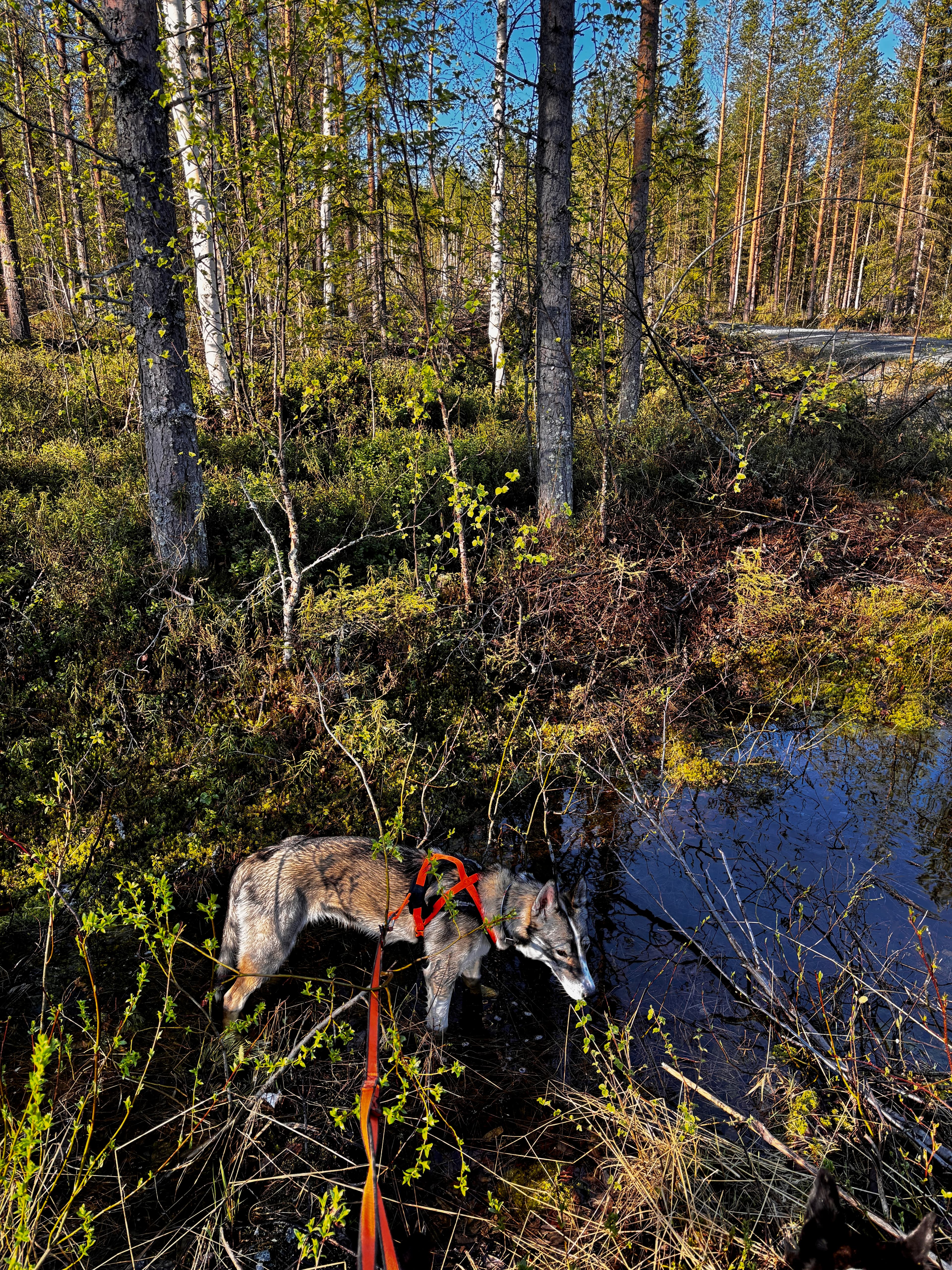
In spring, nature explodes. Trees open their buds within days. First flowers emerge. Everything accelerates, and each day brings its share of surprises — a bird not heard the day before, an area that was frozen and is no longer, a stream that starts to flow where there was nothing.
Reindeer have already gone back north. We do not meet them at this season. Moose, on the other hand, are there. We see them regularly, at a distance, crossing a path or watching the group pass. We stay calm, we let them pass. And there are bears — which live in the region and which we honestly prefer not to meet. We make noise as we walk, we read the traces, we choose open paths.
For equipment, spring requires shoes that hold in melt mud, long clothes (mosquitoes arrive with good weather, and they are no joke), and a small daypack. On longer outings, we always plan a picnic, and the itinerary accounts for it — a sheltered spot to stop, a water point for the dogs.
September and October — the ruska season
Autumn in Lapland has a name: the ruska. It is the moment when birches and rowan trees burst into flame. Bright yellows, oranges, deep reds, all against the background of always-green pines and grey mosses. It lasts two or three weeks, sometimes less, and transforms the entire forest.
Temperatures drop. The air becomes dry, crisp. Light becomes more glancing, more oblique. Days shorten — and with them return the first northern lights, sometimes as early as mid-September if the sky is clear. It is a short season but of rare intensity.
For the dogs, autumn is also when we begin to resume endurance training, in preparation for winter. Serious traction begins again. For a guest who comes canicross hiking at this season, it is sometimes the chance to cross paths with a training run of the team, and to understand that what we do with one's own dog and what we do with a team prepared for ski-joering are really two different worlds — complementary ones.
Mosquitoes have disappeared. Bears begin to hibernate. Moose are still there. And you must start to cover yourself seriously — light gloves, hat, several layers. We often return to the stuga with red cheeks and an immediate desire for sauna.
What dog for canicross hiking?
It is the question that comes back most often, and the answer is broader than one might think.
Your dog does not need to know how to pull. Canicross hiking, unlike canicross racing, does not require traction. The dog can simply walk attached to you, enjoy having a framework, and pull when it feels like it. The elastic leash handles the rest.
What we ask for, however, is an active dog. Outings can last several hours, over varied terrain — you need a dog in good health, with endurance, who likes being outside. No need to be a husky: a shepherd, a sporty mixed breed dog, a fit labrador, many breeds make very good canicross hiking companions.
The real limiting factors are not breed — they are heat, the day's weather, and desire. We always adapt duration and pace based on these three variables. A tired dog, we do not push. Too hot a day, we shorten or leave earlier. A human who no longer wants to, we go back. It is that simple.
And with the Skimate team?
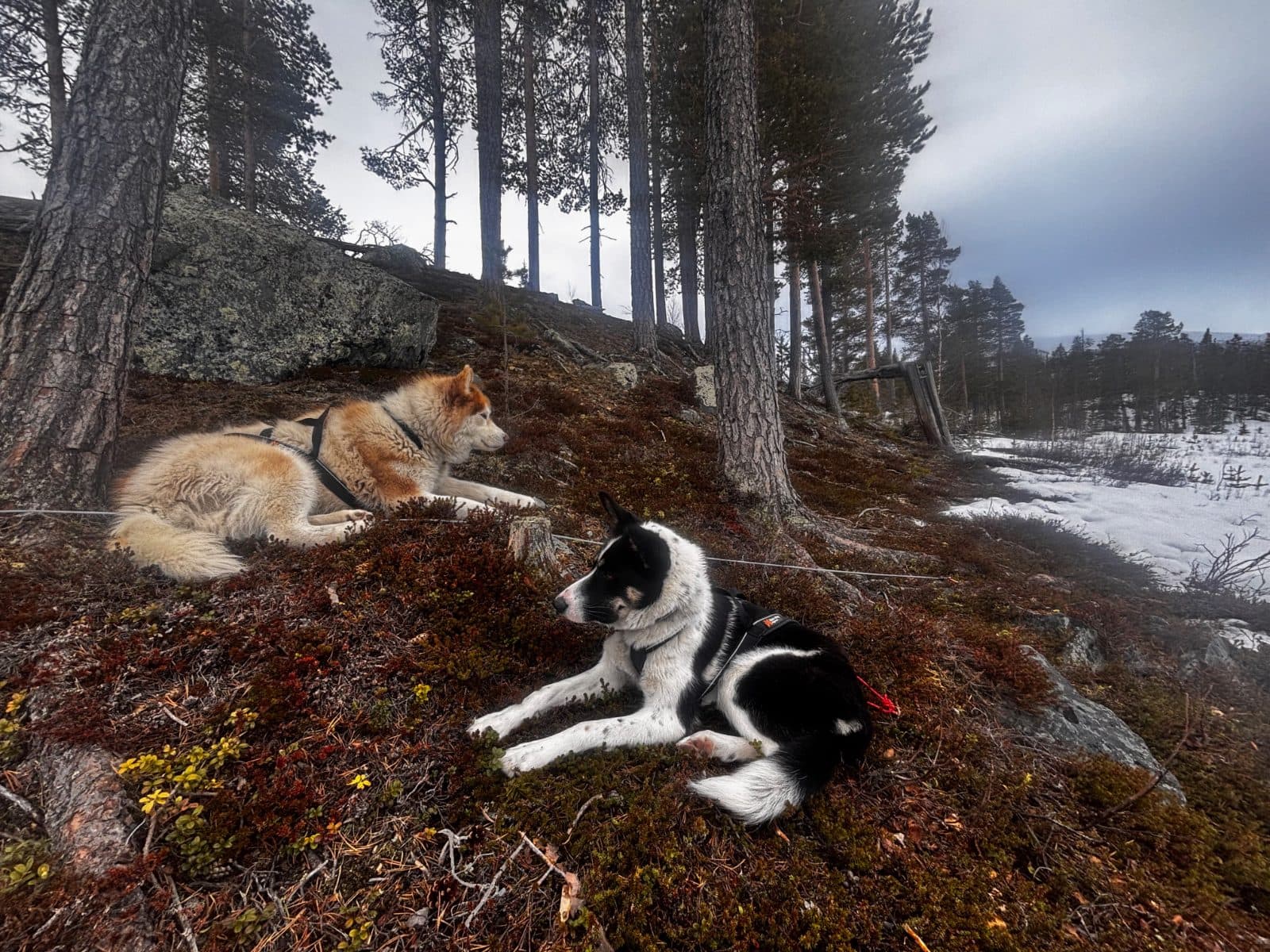
A question that sometimes comes up: can the guest also walk with our dogs? Yes — it is even something we like to offer. Nanga and Hunza are the most comfortable with this kind of outing. The others (Kira, Aïkhal, Api) are a bit too excited for calm walks with a guest — but that does not exclude them altogether. It depends on the day, the outing, the guest.
With Nanga and Hunza, let us be honest: the traction is not guaranteed 100%. They are huskies, they have their temperament. Sometimes they pull hard. Sometimes they stop to sniff something fascinating. That is also what makes the experience real — we are not in a canicross class, we are on an outing with dogs who have their own pace.
Depending on your profile and desire, we can put you with 1 or 2 dogs. It is open.
How a canicross hike goes at Skimate
We leave when it is the right time. Morning for longer outings, afternoon for shorter ones, depending on light and heat. The itinerary is chosen the evening before, together, over coffee or during sauna. We look at the weather, your level, your desire.
Depending on the itinerary, we leave on foot from the stuga, or we drive to a trailhead — the network of paths is immense around Älvsbyn, and some of the most beautiful outings deserve a small transfer. The picnic is planned, the pace is free.
On return, the sauna is warm. That is also the balance of a day at Skimate: effort outside, rest inside, a meal in the evening, deep sleep.
Preparing your visit
To canicross hike with us, you need:
→ Sturdy hiking boots (terrain sometimes wild, sometimes muddy, sometimes rocky) → Long clothes in spring (mosquitoes) and warm clothes in autumn → A small daypack → Your dog, if you have one — otherwise that is fine too, you will go out with one of ours → Your dog's harness (fitted to him, it should not be improvised) → Your dog's European passport, up to date (vaccinations, echinococcus treatment mandatory for Sweden — we can help you prepare)
We lend canicross hiking equipment: elastic leashes and human harness. If you have your own — already tested and comfortable — we recommend you bring it.
In conclusion
Canicross hiking in Lapland is not an activity in the classical sense of the word. It is a way of sharing a few hours with your dog, in a landscape that invites you to slow down. What we describe here, we have lived ourselves — with Nanga, Hunza, and the others — and we have seen it lived by the guests we have welcomed.
If the idea resonates, you can write to us directly at contact@skimate.eu, or use the booking form on skimate.eu. We will get back to you.
See you soon on the paths.
— Kristell
🐾