
Ski-joering in Swedish Lapland — The Skimate Guide
Guide
Published on 1 June 2026
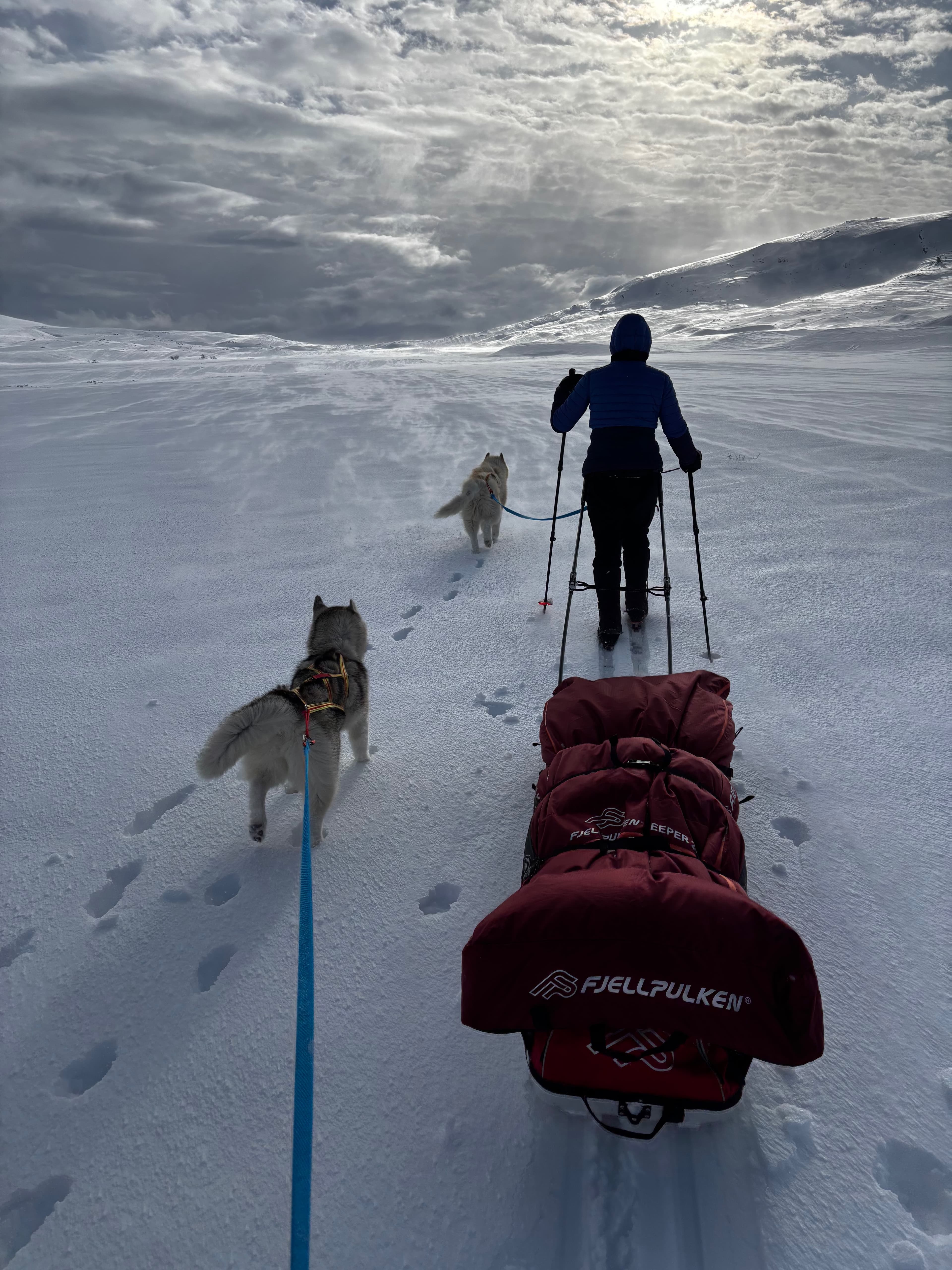
By Kristell · Skimate · June 2026*
Before we talk about what we do at Skimate, a word about the history of ski-joering. The term comes from Norwegian skikjøring — literally "skiing traction". Originally, it was a practical way to move through snowy northern regions: you attached your dog (or horse, or reindeer) in front of you, put on skis, and set off. The discipline is now practiced as a sport — sometimes competitively, sometimes simply for pleasure. With us, it's resolutely the latter.
Ski-joering in practice at Skimate
The principle is simple: a cross-country skier, a dog in front connected by an elastic line to a human harness, and terrain suitable for traction — groomed trails, frozen lake, forest paths. The dog pulls, the skier glides. Together, you move faster and further than skiing alone.
With us, outings begin when we're ready. In the depths of winter, usually mid-day — around the moment daylight appears, about 10-11am. As the daylight lengthens, we shift to afternoon, when temperatures are milder. The Skimate pack trains in the morning for its own sessions, and doesn't necessarily join all guest outings.
For a first discovery, an outing lasts 1 to 2 hours, with Fika along the way. For more experienced guests, we can go 2 hours, a half-day, or even the whole day — and in that case we bring Korv (Swedish grilled sausage) for the midday break. Distance varies from 5 to 20 kilometers depending on what you're after.
The terrain depends on the day. The frozen lake for its straight lines and flat surface, ideal for beginners. The boreal forest and its communal trails for variety. And sometimes, off-piste, wilder trails that we trace ourselves on the Lynx — our utility snowmobile — the day before or that morning. The three combine according to your wishes, the dog's level, the weather.
The dogs: your dog first, the pack second
The idea at Skimate is that you come with your own dog. Ski-joering, you'll do it with him — not with a tourist pack we loan you. That's what makes the experience.
All dogs are eligible — it's important to say upfront. A chihuahua won't pull, that's true. But a shepherd, a husky, a mixed breed, an active and fit labrador: all can ski-joer. We adapt the pace, duration, and the dog's role according to what he's capable of. We seek pleasure, not performance.
You need an active and healthy dog (and a healthy human too!). If your dog has never pulled before, it'll be a bit tough the first few minutes — traction is learned, and some dogs take time to understand. We accompany, but without guarantee of results. And that's normal.
Depending on your skiing level and the terrain, you go out with 1 dog — or 2 if the outing allows. No more. Beyond that, management becomes complicated for a non-confident skier.
The Skimate pack dogs (Nanga, Hunza, Kira, Aïkhal, Api) can complement as needed, but the primary idea remains: it's your dog who pulls.
Required skiing level
Let's be clear: a minimum of skiing experience is required. Ski-joering is cross-country skiing — not for a beginner putting on skis for the first time. If you can ski classic without falling every 50 meters, you can ski-joer by the end of the day. If you can't ski at all, this isn't the right activity.
For non-skiers, we offer snowshoeing — and there's plenty to do on snowshoes in Lapland. In ski-joering, you pick up speed, and speed on snow with a dog in front doesn't come from nowhere.
Note: we ski back-country / Finnish style, not skating. If you want to skate (fast skating style on groomed piste), that's possible but you'll be on your own — we don't practice that style.
Equipment
Human side
Skis: we provide Finnish skis — a wide, stable back-country ski that mounts on regular winter shoes (après-ski type). It's less fast than competitive cross-country skiing, but much more practical: no need for special shoes, no need for advanced technique. For more demanding itineraries (like Kungsleden), you'll need to rent back-country skis from a shop.
Shoes: warm winter shoes, any brand. No need for specialized equipment.
Harness: we loan a ski-joering harness — a canicross harness can also work, so if you already have yours tested on outings, bring it.
Cold weather clothing: adapted to Scandinavian climate. Perspiration is the real problem, not cold itself. Too warm during effort, you sweat, you cool down at stops. 3-layer technical system, and adjust throughout the day. We'll write a dedicated resource article on clothing.
Accessories: sunglasses category 3 minimum
A hat and a neck/nose gaiter like a Buff, an essential headlamp (days are short), and a ski mask for very cold or windy days.
Dog side
Harness: the ski-joering harness is the same as canicross — to be brought by the owner, adjusted to your dog.
Line: usually longer than canicross, around 2m80. We have some in advance.
Booties (snow shoes): depending on dogs. Some need them in extreme cold or on crystallized snow, others never.
Cold weather vest: depending on breed and weather. Some short-haired dogs need them at -25°C, others not at all.
Basic directional commands: your dog must know basic orders: right, left, stop, forward (or other command)
What the guest must bring
→ Personal items: warm winter shoes, gloves, hat, balaclava, headlamp, ski mask, thin + thick socks, technical base layers → Sunglasses cat. 3 → Your dog's harness (adjusted to him) → If you have your own human harness tested, bring it — otherwise we loan → Your dog, his up-to-date European passport (echinococcus mandatory)
What we loan
→ Finnish skis → Snowshoes → Poles → Human harness → Ski-joering lines
We'll also post a dedicated resource article on complete equipment — it's a whole subject in itself.
Safety
Let's be honest: the real risk is falling. Ski-joering is speed on a surface that can be very soft (powder) or very hard (ice, packed snow). Off-piste, there are sometimes roots or rocks under the snow. Sprains, bruises, falls — that's part of the game. It's not dangerous, but it requires caution.
First outing for a beginner
We stay with you the entire outing — that's non-negotiable. The first time, we ski alongside to supervise. We start on a groomed lake trail (flat, wide, no surprises), then adapt according to your comfort. Coffee break along the way. No pressure on distance or pace.
What if the dog bolts?
If your dog bolts, don't panic, lower your center of gravity by bending your knees to try to crouch and lay yourself on the side to stop the bolting rather than trying to brake standing up. True story: Gilles pulled by three dogs, a reindeer herd in the distance. I hoped they wouldn't see the reindeer. Wrong. Eighty-five kilos of meat tractioning at full power on the lake ice — and not on the skis. Outcome: no reindeer caught, no dogs hurt, and a Gilles slightly vexed :-)
What if the dog refuses to pull?
Nothing to do — Stay calm, ski alongside, and enjoy the landscape. Not all dogs want to pull every day. That's also why we don't focus on performance.
In extreme cold (-25°C, -30°C)
We still go out, adapting: shorter outings, we cover up more, we plan hot drinks at stops, we avoid prolonged breaks. Dry cold is more bearable than it seems — it's humidity and wind that are complicated, not absolute temperature.
Multiple guests, multiple dogs
If multiple guests go out at the same time, humans remain responsible for their dog. We keep distances, control, and we avoid putting dogs together without supervision. There are very few places where dogs could meet without oversight.
What it feels like on first traction
It's hard to describe to someone who's never experienced it. A sense of speed, first — much more than you imagine. And a sense of loss of control — the dog goes at its rhythm, not yours. The skier learns to trust, to let themselves be pulled, to become a partner instead of a pilot.
For our part, what we love — it's the sound of ski on snow, and the silence around it. No engine, no shouts (except at start when dogs are very excited), just the dog's breath, the glide, and the forest rushing past.
The full story of why we chose this activity as the heart of Skimate is on our story page. In summary: we're "gentle dreamers" — humans with few dogs, with no competition goals whatsoever. Ski-joering as we practice it is that philosophy embodied in an activity.
Ski-joering season in Swedish Lapland
The season starts when the snow layer is sufficient and stabilized to be groomed. With us, we reckon three good snowfalls are needed for a proper base. The lake, meanwhile, freezes around mid-November — that's our observation after a first season here. From then on, it's go for long months.
Best month to discover ski-joering with us: February and March. Less cold than deep winter, more daylight, stable snow conditions, real possibility of seeing auroras in the evening.
Snow conditions: variable. From fresh powder to groomed trails, including wind-packed snow on the lake. Each outing is a bit different.
Northern lights: possible only in the evening, so during a planned night outing. Not on day outings. But a ski-joering night outing under auroras — that remains one of the most striking experiences we can offer you.
Cani-rando or ski-joering: how to choose?
Many prospects ask us this question. Let's be clear: they have nothing in common. Everything is different — effort, equipment, temperature, pace. Ski-joering involves cold. If you don't like cold, don't come to Sweden in winter, it's that simple.
Cani-rando is practiced in spring and autumn, walking. Ski-joering in winter, skiing. You can like one and not the other — that's fine. You can come once to discover ski-joering, and return another season for cani-rando.
Preparing your visit
To "ski-joer" with us, you need:
→ Minimum skiing level (able to classic ski without falling every 50 meters) → Your dog, athletic and in good health → Your dog's ski-joering harness (adjusted to him) → If possible, your human harness tested on outings — otherwise we loan → Your cold weather clothing (technical layers, gloves, hat, balaclava, mask, cat. 3 sunglasses) → Your warm winter shoes → A headlamp (days are short) → Your dog's up-to-date European passport (vaccines, echinococcus treatment mandatory for Sweden — we can help you prepare)
We loan: Finnish skis, snowshoes, poles, human harness, ski-joering lines.
To finish
Ski-joering in Lapland is not a catalog activity. It's an encounter — between terrain, a dog, and a person who accepts being pulled. It's speed, silence, the sound of ski, and sometimes a reindeer herd you would have preferred not to meet.
As Kristell would say after a good outing, by the sauna: *"That was too good! Can't wait for tomorrow."
If the idea resonates, you can write us directly at skimateeu@gmail.com, or use the booking form on skimate.eu. We'll get back to you.
See you on the snow soon.
— Kristell 🐾


