Skimate and MushMate — when fieldwork feeds code
Published on 1 September 2026
MushMate — when an application is born from a shared need among gentle dreamers
Most sports applications are designed behind a screen, by teams who rarely—or never—practice the activity they're building for. It's efficient for shipping fast. But in a field as specific as mushing, this distance between the designer and the terrain eventually takes its toll—recommendations that make no sense, entire use cases forgotten, principles poorly borrowed from another domain.
MushMate was born from the opposite position. It's a tool built by a couple of amateur mushers who live daily with their pack in Swedish Lapland, as part of their hosting camp Skimate (skimate.eu). The application emerged from a personal need first, then quickly recognized as shared by a dozen musher friends in our circle—all the same profile as us: few dogs, no competition, the desire to do things well.
A few months after the first lines of code, it will be in public BETA this weekend on Android. iOS will follow in the coming months.
This article tells how the application was born, what it does today, what it doesn't yet, and why being born from fieldwork—that of gentle dreamers rather than competitors—changes something about what it is.
The origin — six years with Nordic dogs
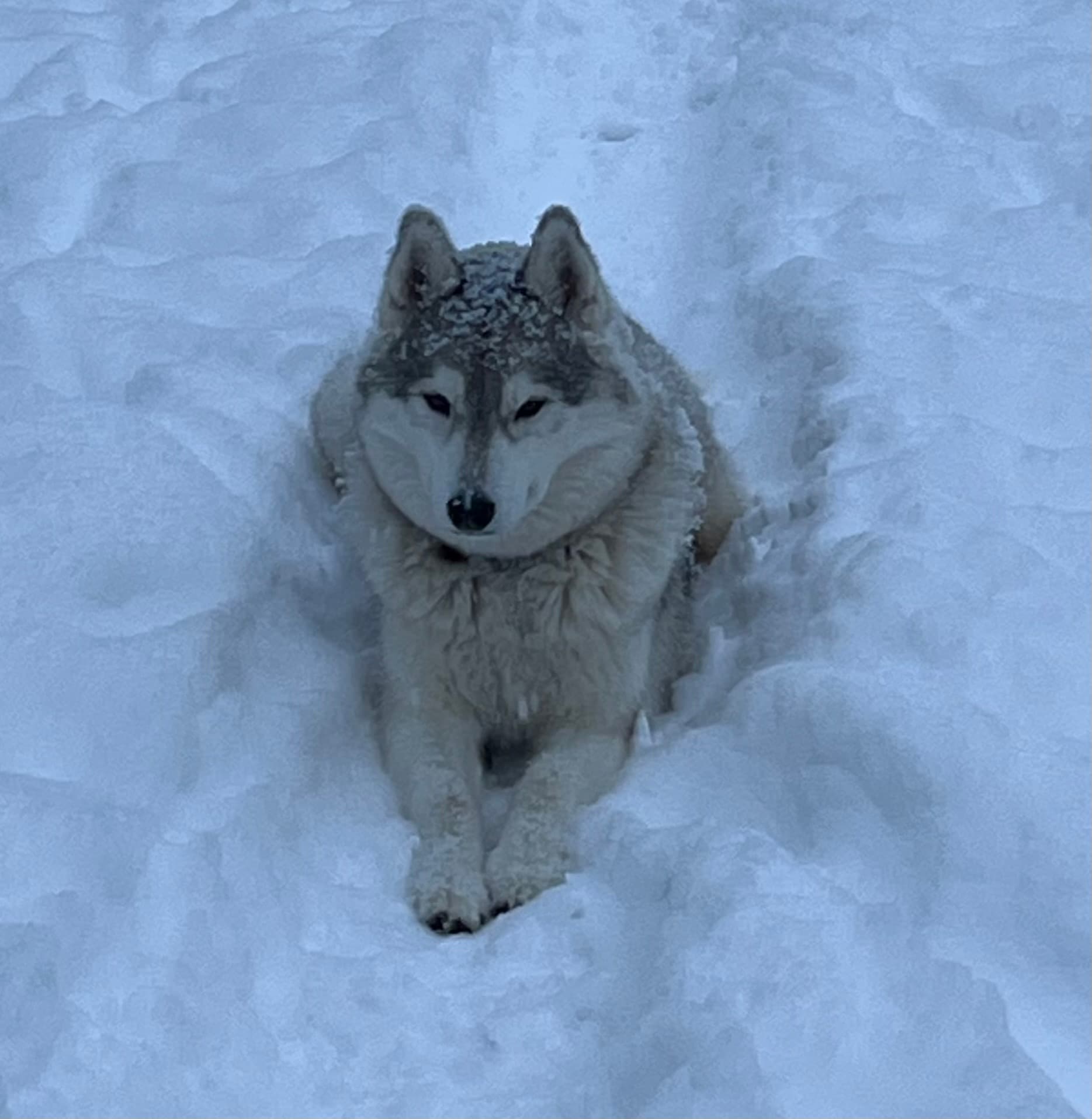
It all started in November 2020 with Nanga, our first husky. A beautiful red who accompanied us everywhere—the Alps, Pyrenees, Norway, Sweden, Switzerland. A year and a half later, Summa joined us. Then Hunza, after moving to a new region and a long two-month winter ski journey through Norway and Sweden.
Three dogs. Amateur practice, no competition. Six years of understanding what mushing demands—physically, mentally, logistically.
Like many amateur mushers, we organized ourselves with what we had—a paper notebook for vaccines, an Excel spreadsheet for training, a human sports app repurposed to log outings.
It wasn't perfect, but it held for three dogs.
Two events shifted this balance.
First, our move to Swedish Lapland in October 2025, at 65°N, to live as close as possible to nature in an environment suited for traction activities. The pack naturally grew—Kira, Aïkhal and Api joined us at our move. Then Djuma in August 2026. Today it stands at six dogs, and we'll be nine in the coming days with the arrival of a new generation of puppies.
Then, talking with the mushers around us—a dozen regular practicing friends, in France or elsewhere in Europe—we realized our frustration wasn't isolated. All the same profile as us: few dogs, no competition, wanting to do things well without drowning in spreadsheets. Each of them told us the same thing: Excel spreadsheets that became unmanageable beyond two or three dogs, human sports apps repurposed that didn't correctly track female cycles, vaccines, litters, existing paid solutions but designed for a user with one dog—not for a household with multiple animals with different needs.
We seriously searched for an application that would do what we wanted. We tested several market solutions. None really fit.
We decided to build what we couldn't find.
It wasn't an ambition. It was a shared need looking for a solution.
A few months of development, two people
We're not a software development company. Gilles has a job in tech alongside this. Kristell runs the Skimate camp day-to-day. Neither of us had built a complete mobile application before this project.
The first serious lines of code date from early summer 2026. Two months of intense development, mostly evenings and weekends. Kristell tested everything in real conditions with our pack and reported back every friction point. Gilles coded, broke things, fixed them. Our musher friends in closed beta reported back each week what was missing.
One figure to give an idea of the intensity of recent work—in the last three weeks of August alone, we shipped nearly 300 improvements and fixes in the application. The release log is published in our code repository, it's not marketing, it's the real log of the work.
The application is today in public BETA. It's young, it has bugs, it has gaps. We don't hide that.
What MushMate does today
The application is structured around seven functional areas. We summarize here the main points, with honesty about what's solid and what still needs improvement.
1. The training model
This is the heart of the application. Each dog receives an individualized plan based on their age, life phase, main discipline (sledding, canicross, bikejöring, scooter), current condition, position in the team, real weight of equipment used, and intended goal.
The plan is broken down into four phases (base, intensity, peak, recovery), with continuous regeneration from logged outings and noted feelings.
Recent rebuild. This summer, we rebuilt the model from the ground up, basing it on real physics rather than formulas borrowed from human sports. A dog weighing 25 kg pulling an 80 kg sledge on a 3% slope is no longer modeled like a human runner of 70 kg—it's what it really is. A concrete example of what changed: our initial model overloaded canicross by about 66% because it treated the musher as weight to pull, when in canicross the musher runs alongside and only pulls a line.
What remains open. Full veterinary validation of this new model is currently underway. We don't claim to be "scientifically validated" in the strict sense—we're talking about a model based on defensible physical principles, awaiting veterinary sign-off.
Still to come on this module: the version for sprint programs (we only build mid and long distance programs today), post-race taper (the plan currently continues to increase after a race, which makes no physiological sense), and cross-training (strength work, swimming, free running off-harness).
2. The health record
Each dog has a complete record: vaccinations with reminders, deworming and treatments, complete cycles (heat, duration, notes), weight over time with curve and body condition score, injuries and follow-up, veterinary notes, photos and PDFs as attachments.
Key principle. Health drives training. When a dog is in treatment, injured, recovering, or nursing, the training engine automatically adapts their plan. Impossible to schedule a demanding outing for a dog who isn't in condition.
3. GPS outings
Complete logging: distance, speed, route, elevation gain, timeline events. Works fully offline—syncing happens when you're back online. Recent addition: handlebar mode with live map, planned route displayed, camera following position.
4. Reusable teams (rigs)
You design your team once—position of each dog, line lengths, single/double file or fan config. You save it as a template. You reuse it each outing or race.
The application knows federation rules and automatically alerts if the config doesn't match. It also flags dogs that shouldn't be in the team—young, injured, pregnant, nursing, retired.
5. Breeding and litters
From birth to weaning: birth tracking (time, order, weight), temperature and weight alerts in the first days, weight curves by puppy, veterinary care log per litter, handover record ready to print.
6. Equipment tracking
Harnesses, lines, sledge: usage tracking, maintenance, size adapted per dog, shared brand catalog.
7. Collaboration
Inviting handlers, veterinarians, or observers—each with different permissions. Kennel dashboard that shows at a glance who's fresh, who's tired, who needs attention.
What remains imperfect
We're opening public BETA knowing the application isn't finished. Two months of development is short. Here are the gaps we know about—the ones we're not hiding:
No iOS. The application was never built for iOS. That's our near-term priority. If you're on iPhone, you'll need to wait a few more months.
Veterinary validation underway. The physical model is mathematically solid but doesn't yet have the sign-off of a veterinary specialist in sport dogs.
Sprint programs absent. Today the application only builds mid and long distance programs.
Cross-training not integrated. Strength work, swimming, or free running aren't yet integrated into the plan.
Legal documentation in process. Our privacy policy and terms are in legal review.
Young application, still has bugs. The application is two months old in development—that's short. There will be bugs. We fix them fast, but there will be some.
We publicly list our complete roadmap, with its dark spots and gaps. It's a way of telling beta testers: here's where we are, here's what you can expect, and here's what you can't yet have.
How to participate in the BETA
The application will be downloadable on Google Play at the end of the week, under the name MushMate. Registration happens directly in the app.
Pricing. 30 days free trial with access to all features. Then €5/month via Google Play (multi-country, prices auto-adjusted in local currency).
To report a bug, suggest an idea, ask a question, or give general feedback: a form is built into the app ("Feedback" button accessible everywhere). We handle each report, usually within 24-48 hours. For private or sensitive cases, a dedicated email: skimatemusherapp+beta@gmail.com.
Our commitment during this BETA period: respond to each bug report, visibly iterate on community priorities, regularly publish what we ship and what we fix.
What's coming in the next few months
Our immediate roadmap contains:
- iOS version (maximum priority)
- Improved Strava integration
- Cross-training integrated into the plan
- Sprint programs
- Post-race taper—the plan should go down after a race, not up
- Trail safety and hazard maps on offline maps
- Complete veterinary validation of the physical model
- Support for additional languages (Norwegian notably)
We prioritize based on BETA feedback. The season is starting, it's when the application will be tested in conditions that matter.
Why fieldwork origin changes something
We conclude on this observation, which is also the reason for this article.
An application developed by a team that doesn't practice what they're building for always ends up with blind spots. Forgotten use cases. Principles poorly transposed. Terrain truths invisible from a desk.
MushMate isn't immune to these limits. It's young, two months of development. We have our own blind spots. But we have two things few dog sports applications have today: six years of amateur practice that fed every product decision, and a circle of a dozen musher friends with the same "gentle dreamers" profile who tested and honestly reported what wasn't working from the start.
It's a slow pace. It's also what, we hope, gives MushMate its robustness—even at this early stage.
Thank you to everyone who will test in the coming weeks. Your feedback will shape what's next.
Kristell & Gilles Älvsbyn, Swedish Lapland August 2026